
Follow & Subscribe to Resourceful Designer
Why Hobbies Are Your Secret Weapon for Business Success.
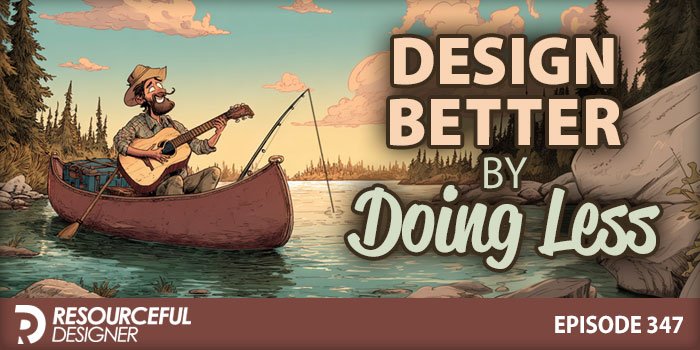
What if I told you that picking up a guitar, going fishing, or spending an afternoon in your workshop could make you a more successful designer and boost your business performance by as much as 30%? It might sound counterintuitive, but bear with me, because this truth can be a true game-changer for your creativity, productivity, and even your bottom line.
As designers, many of us feel the pressure of deadlines, demanding clients, and constant screen time. It’s easy to convince ourselves that the path to success is paved with long hours and tireless hustle. After all, isn’t “grinding” the name of the game? But I’m here to tell you that sometimes the best thing you can do for your design business is to walk away from it, at least for a little while.
A Tale from the Garden: Creativity Takes Root Away from the Screen
Let me start with a story that drove this message home for me. Not long ago, I caught up with Stephanie, a talented web designer I met at WordCamp Canada. Like many of us experience, Stephanie was in a slow period between projects. The kind of lull that can make us anxious. On one of Ontario’s last warm fall days, she made a decision that instead of sulking at her desk, she’d spend the day preparing her bountiful vegetable garden for next season.
While she was elbow-deep in soil, her phone buzzed with “urgent” client messages. Like most of us, her first reflex was to ditch the gloves and dive back into work. But then she remembered something she’d heard on Pat Flynn’s Smart Passive Income podcast: entrepreneurs with creative hobbies outperform their fellow business owners by up to 30%. That day, Stephanie chose to tune out her notifications and stay in her garden.
Here’s where it gets interesting: not only did she make progress in her garden, but somewhere between the weeding and mulching, she had a breakthrough idea for a personal project she’d been completely stuck on. The lesson? Sometimes, giving yourself space is precisely what your ingenuity needs.
My Workshop Epiphany
This isn’t just Stephanie’s story. Reflecting on her experience made me think about my own woodworking hobby, something many of you know I’m passionate about, even if I don’t indulge as often as I’d like. Recently, while sanding down a cutting board in my workshop, I found my mind drifting to a troublesome client project. I’d been wrestling with a finicky e-commerce shipping issue, burdened by budget constraints and technical limitations.
Surrounded by sawdust, with my hands moving and my mind free, an elegant and free solution unexpectedly popped into my head. I’d completely overlooked it at my desk, but the answer appeared away from the screen. When I returned to the project, it was implemented seamlessly, and my client was delighted.
The Science: Why Hobbies Make Us Better Designers
These aren’t just happy accidents; there’s hard science at play. When we engage in hobbies, especially ones that are very different from our professional work, our brains enter the “default mode network,” sometimes referred to as our creative background processor. While we garden, build, or strum, our minds continue to work in the background, connecting ideas and resurfacing solutions.
In fact, studies show that entrepreneurs dedicating just two hours a week to creative hobbies report a 30% improvement in work performance. That’s not an insignificant bump; it’s fuel for your business engine.
Fighting Burnout & Creative Fatigue
I know what some of you are probably thinking: “Mark, I don’t have a free minute for hobbies! How could I possibly fit this in?” Trust me, I get it. There was a time when I pushed myself well past my usual work boundaries, convinced that sacrificing my downtime for a big redesign project would help me succeed. The harder I worked, the harder it became to generate fresh ideas; my spark dulled, and my tasks dragged on.
By chance, life forced me to take a breather. My daughter was home, sick from high school and needed help building a popsicle-stick bridge for physics class. That precious father-daughter time was light-years removed from my project stress. When I returned to my desk the next day, tasks suddenly flowed, ideas clicked, and the finish line felt much closer.
The truth is that roughly 43% of freelancers experience burnout, a statistic that hits especially close to home for designers, whose work demands endless creative output. The most potent antidote? Hobbies that have nothing to do with design. The more different, the better. Physical crafts like woodworking, hands-in-dirt gardening, music, cycling, even cooking, you name it. If it uses other senses and shifts your focus, you’re refuelling your creative reservoir.
Actionable Steps: Design Smarter, Not Harder
Ready to experience these benefits yourself? Here are three actionable strategies to start integrating this approach right away:
Schedule Your Hobby Time
Block at least two hours this week for a non-design activity you truly enjoy. Put it in your calendar as if it’s a client meeting. Don’t let anything bump it.Create Physical Boundaries
When you’re engaged in your hobby, silence your phone, put it on airplane mode, or (better yet) leave it in another room. This isn’t just “downtime,” it’s your powerful, creative recovery time.Track Your Results
Jot down how you feel after your hobby sessions, and note any creative breakthroughs, easier client interactions, or improved productivity you notice. You’ll soon have your own evidence of this strategy’s value.
And if you work from home, as I do, carve out a dedicated space for your hobby, far from your usual work spot. That separation helps your brain seamlessly shift from work mode to recovery mode.
The Bottom Line
Taking time for hobbies isn’t a sign of laziness or unproductivity. It’s a strategic, research-backed decision that can make you a more creative designer, a better business owner, and a happier human. Sometimes the best way to move your design business forward is by stepping away, recharging your mind, and letting inspiration quietly do its work in the background.
So, what hobbies are you passionate about (or hoping to start)? I invite you to join the Resourceful Designer Community and share your journey with us. Reach out to me on social media or email me at feedback@resourcefuldesigner.com. I’d love to hear your story.
Take action this week:
Book time for your hobby, set boundaries, and watch your creativity and business soar. Remember, the best breakthroughs often arrive when you least expect them, sometimes in a garden, sometimes in a workshop, and always when you permit yourself to do a little less.
Let me help you.
Running a graphic design or web design business alone isn't easy. If you're facing any struggles running your design business, please don't hesitate to reach out. I'll do my best to help you by addressing your issues in a future article or podcast episode here at Resourceful Designer. You can reach me via my feedback form
You can also follow me on Twitter, Facebook and Instagram
My Voice-Over Guy.
The amazing Wayne Henderson of MediaVoiceOvers.com performs Resourceful Designer podcast intros. Wayne is available to help you with any voice-over work you require.
